No 2M
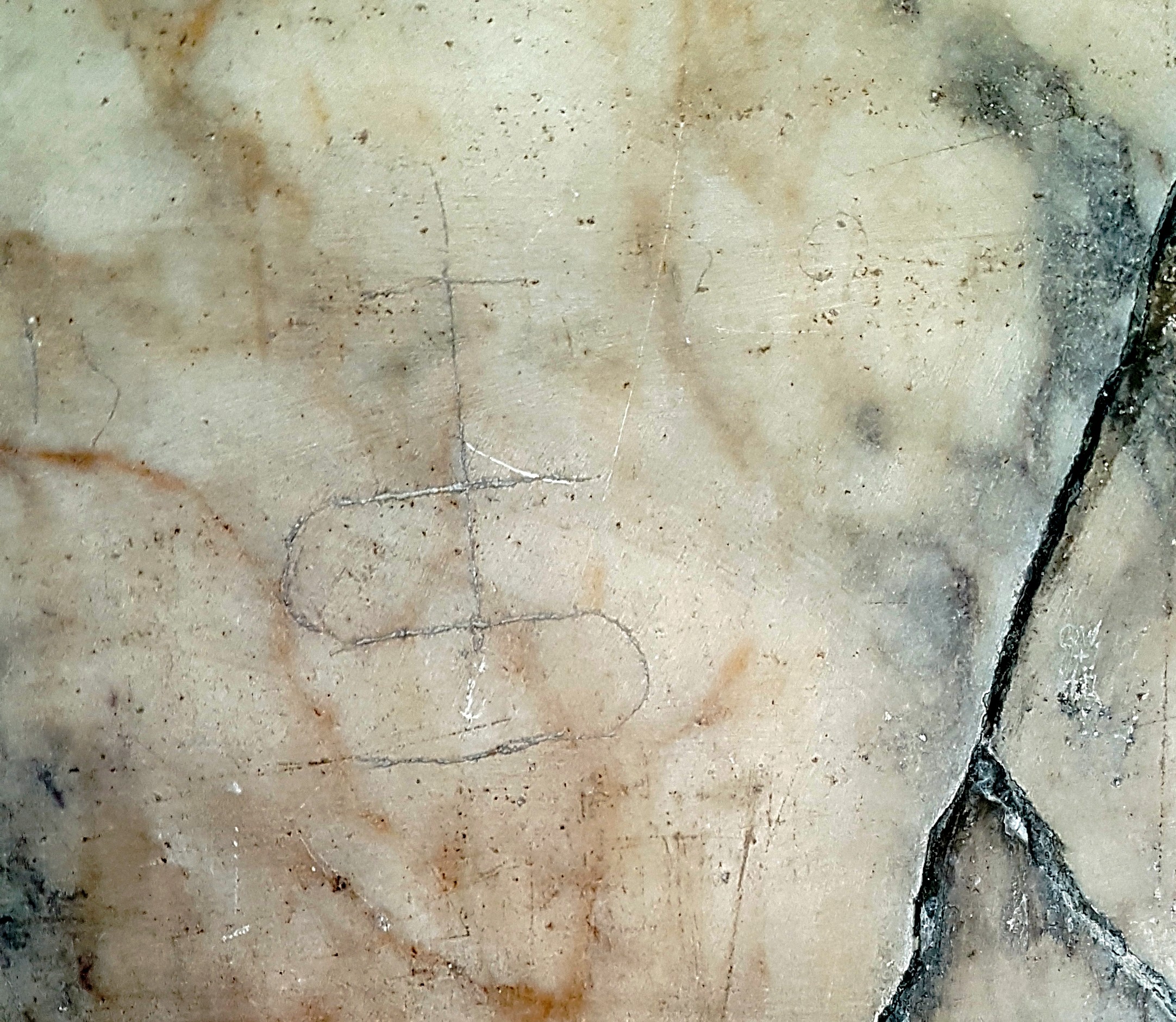
Location: To the left of door No. 49 in the south wall of the central part of the southern gallery, at 140 cm from the floor level.
Material: Marble surface, 6th century.
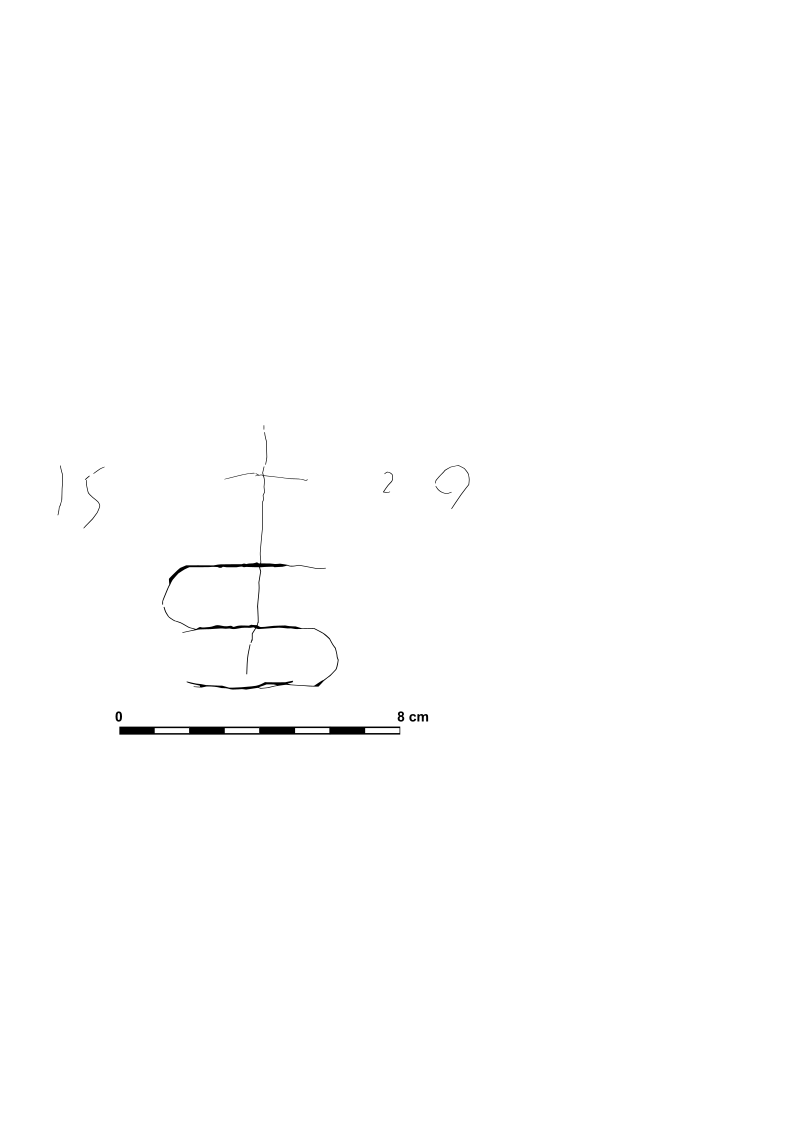
Dimensions: The S, including the cross, is 7.6 cm high and 5 cm wide. The numbers "15" and "29", which form the year 1529, are positioned 3.5 cm from each side of the crossbar. The height of these numerals varies from 0.6 cm (for the "2") to 1.8 cm (for the "5").
Condition: Shallow incised, not intersected by other marks.
Technique: Incised.
Description: The drawing represents a Latin letter S surmounted by a Latin cross and accompanied by the year.
Attribution: The "Crux Sanctus" monogram, serving an apotropaic function.
Publications: E. M. Αντωνιάδου, Έκφρασις της Αγίας Σοφίας: ήτοι μελέτη συνθετική και αναλυτική υπό έποψιν αρχιτεκτονικήν, αρχαιολογικήν και ιστορικήν του πολυθρυλήτου τεμένους Κωνσταντινουπόλεως. T. 2. [Αθήναι]: Τύποις Π. Δ. Σακελλαρίου, 1908, 322, Fig. 440; Toma Tomov, Četiri grafita ot „Sv. Sofija/Aja Sofija“ v Konstantinopol/Istanbul, V: HUMANITAS, PAIDEIA, ETHOS. Sbornik v čest na prof. d-r Cvetana Čolova, Sofija: NBU, 2025, 109.
Commentary: The letter S of the monogram can be interpreted as an abbreviation for "Sancti," which, combined with the cross (+), forms the phrase "Crux Sanctus" (Holy Cross). Alternatively, the monogram may represent a prayer invocation, such as "Crux, Salva me!" (Cross, save me!). In this interpretation, the cross serves as a symbolic invocation (invocatio symbolica). An expanded reading could be: the cross (+) stands for "In nomine Patris et Filii, et Spiritus Sancti. Crux..." and the S for "Salva me!". While it is difficult to determine which interpretation is more accurate, the first one (Crux Sanctus) appears more probable.
Date: 1529.