No 6H

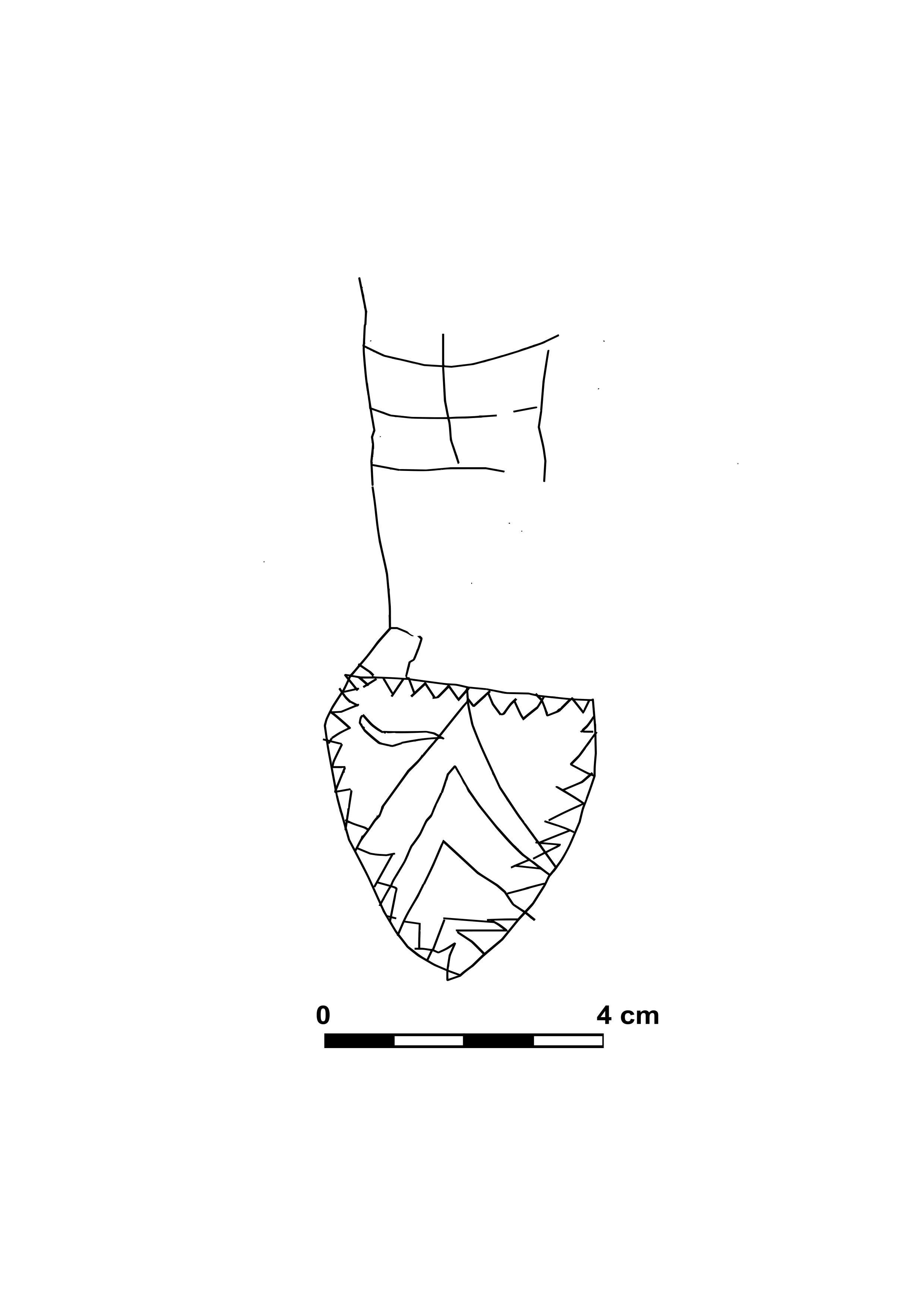
Location: Southern gallery, east exedra, north-east column.
Material: Marble surface, 6th century.
Dimensions: Width 3.7 cm, height 9.3 cm; at eye level.
Condition: Clear but uncertain engraving, not intersected by other marks.
Technique: Incised.
Blazon: (Chevronnè of four? two chevrons?), in dexter canton of chief a (ship? Dragon?), and a bordure indented. Gothic-shaped shield; on the outside, above the right corner of the chief, rests a vaguely trapezoidal figure on which is the long pole of a flag (or banner), waving towards the observer's right and lacking on the free edge, divided symmetrically into four parts by two cross-shaped lines.
Аttribution (Th. Thomov): None.
Attribution (M. Gorra): Undetermined.
Commentary: This engraving contains significant ambiguities that pose a serious obstacle to the accurate blazon of the coat of arms (as is evident from the parts placed in brackets and with a question mark), and which preclude the possibility of theoretically identifying the owner based on the heraldic content, which is apparently quite characteristic. The uncertain execution prevents us from determining the number and nature of the chevrons on the shield, which, incidentally, are used by quite a few families[1].
Nevertheless, the figure placed in the dexter canton of chief (unfortunately of an indeterminable nature) and the indented bordure are certain, useful for directing research toward heraldic regions where their use is found, particularly as cadency marks for secondary branches of a family[2].
The Italian region of Tuscany offers numerous examples of figures that in the dexter canton of chief distinguish the branches of individual families (noteworthy is the case of the Bardi, Ceramelli Papiani). However, among all, the Da Filicaia family appears to be the only one that places them in a coat of arms containing more than one chevron [3]. Other chevrons are used by the Guasconi, Mannucci, Armellini, and Del Nero Cambi Importuni families also use chevrons, but indented bordures are few.
Historical research confirms that the Da Filicaia family is known for its admirals and navigators, but they sailed west of Italy. The most famous among them is Alessandro, who lived in the 17th century, but there is no evidence that he reached the Bosphorus. Another member of the family is also known, Averardo (unknown in what capacity), who appears in a letter dated August 16, 1499, from a certain Bartolomeo di Bambello to the Medici from Constantinople[4].
In the Italian territories, the indented bordure is a heraldic element widely used in the Kingdom of Naples and was probably influenced by French heraldry, but coats of arms with multiple chevrons are less common (the most typical belongs to the Del Tufo family, and it seems that none of them used it. Even rarer are coats of arms with figures in the canton[5].
The flag or banner outlined above the shield suggests a potential connection with the city of Genoa, whose coat of arms always features a cross, but the poor execution of the graffito gives it a minimal appearance. Incidentally, even in the Genoese region, coats of arms with multiple chevrons are limited (among all, the most notable is that of the Fornari, owners of the eponymous Albergo, but even here, variants with figures in the canton or with an indented bordure have not appeared, as they were rarely used in that region) [6].
Coats of arms with chevrons and an indented bordure can also be found elsewhere in Europe, particularly in the French regions, but broadening the field of research makes the search more uncertain and further complicates possible connections with Constantinople[7].
Date: 15th–16th century AD.
[1] Gorra, 10) Santa Sofia a Costantinopoli.
[2] Gorra, 10) Santa Sofia a Costantinopoli.
[3] Gorra, 10) Santa Sofia a Costantinopoli.
[4] Gorra, 10) Santa Sofia a Costantinopoli.
[5] Gorra, 10) Santa Sofia a Costantinopoli.
[6] Gorra, 10) Santa Sofia a Costantinopoli.
[7] Gorra, 10) Santa Sofia a Costantinopoli.