No 4H

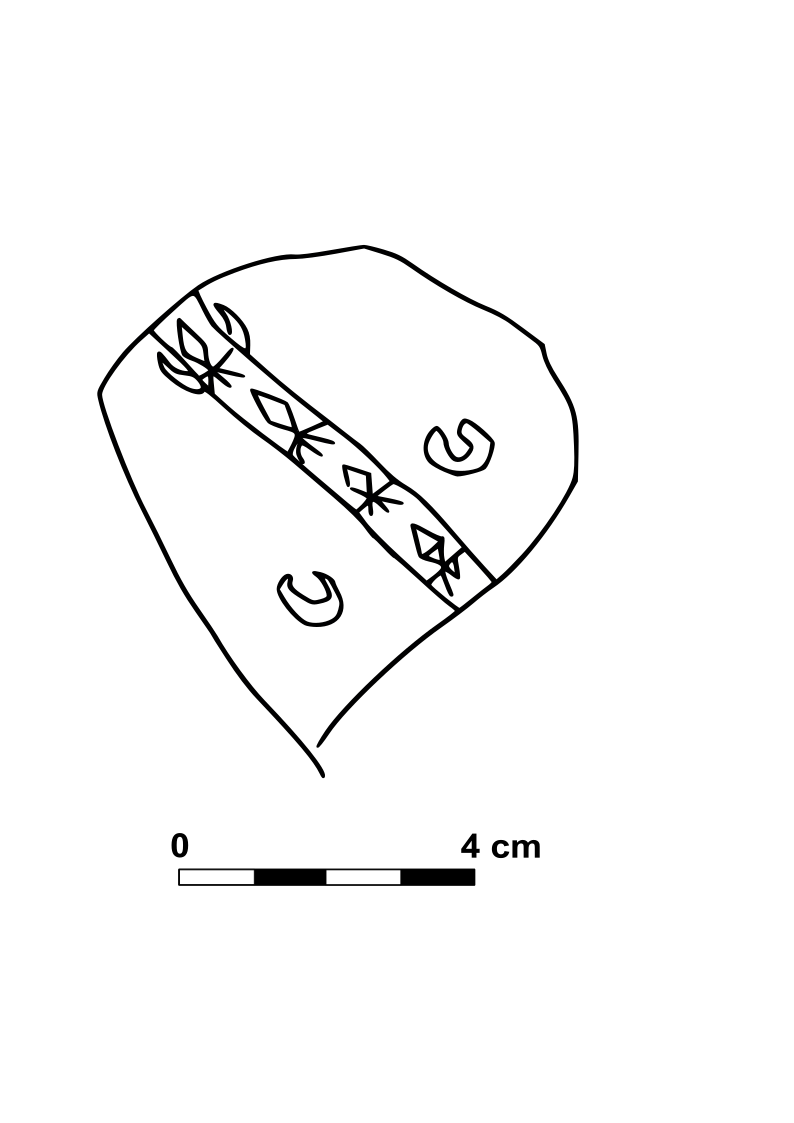
Location: Southern gallery, western exedra, north-west column.
Material: Marble surface, 6th century.
Dimensions: Width 6.5 cm, height 7.5 cm; about 152 cm above floor level.
Condition: Clear engraving, interlaced with others but not obliterated.
Technique: Incised.
Blazon: A diminished bend with four lilies between two crescents, oriented along the division, crossing a third crescent, reversed in the dexter canton of the chief. Gothic shield.
Аttribution (Th. Thomov): Machingi family (Florence).
Attribution (M. Gorra): Agrees with the above.
Publications: Tomov, T. Gerbove-grafiti ot hrama „Sv. Sofija“ v Konstantinopol, BǍLGARSKO CARSTVO. Sbornik v čest na 60-godišninata na doc. d-r Georgi N. Nikolov, Sоfia: Universitetsko izd. "Sv. Kl. Ohridski" 2018, 687-692; Gorra, Maurizio. Observations and reflections on some coats of arms graffiti in Santa Sofia in Constantinople, Academia.edu
Commentary: A coat of arms of complex composition, yet carefully executed by the anonymous “engraver.” The specifics of the Machingi arms leave little doubt. Sources for the family are relatively scarce: G. B. di Crollalanza, Dizionario storico-blasonico delle famiglie nobili e notabili italiane, estinte e fiorenti, Pisa, early issues of Heraldic Journal 1886/1890, vol. II, p. 43, confirms the arms and notes the family’s extinction in the 19th century; E. Gamurrini, Istoria genealogica delle famiglie nobili toscane, et vmbre (five volumes), Florence, G. Navesi 1668/1685, and other authors record the family name in the form Macigni. A fine example of the arms is found in the manuscript Deputazione sopra la nobiltà e cittadinanza, Libro d’oro del patriziato di Firenze, quartiere di San Giovanni II (State Archive of Florence, ms. 194, f.2, see Appendix 8).
For now, there is data for only one member of the Machingi family in Constantinople: in December 1613 Carlo Machingi, called “Maltese knight” and commissioned by the Grand Duke of Tuscany, set out on a naval expedition to Caifa during which he was to “as the occasion required circumvent Soria” (n.n. [I. Riguccio Galluzzi], Istoria del granducato di Toscana, Florence, G. Cambiagi 1781, vol. III, p. 341), returning before August 1614 (n.n. [G. Mariti], Istoria di Faccardino grand-emir dei Drusi, Livorno, T. Masi and companions 1787, p. 149). This may have been the same Carlo who for a period was the chief vicar of the bishop of Volterra Luca Alamanni (1598–1612): described as a “noble cleric and Florentine doctor,” Machingi was an apostolic protonotary, a member of the Accademia della Crusca (contributing to the compilation of the Dictionary first published in Venice in 1612), an expert in law and liturgy, and the author of at least two books (one of which is here). For these data see Volterra City site.
The attribution to cleric Carlo Machingi is further supported by the shield’s shape - the only droplet-shaped one in this study - fully consistent with the curial style of his time.
Date: 15th–16th century AD.