No 27D

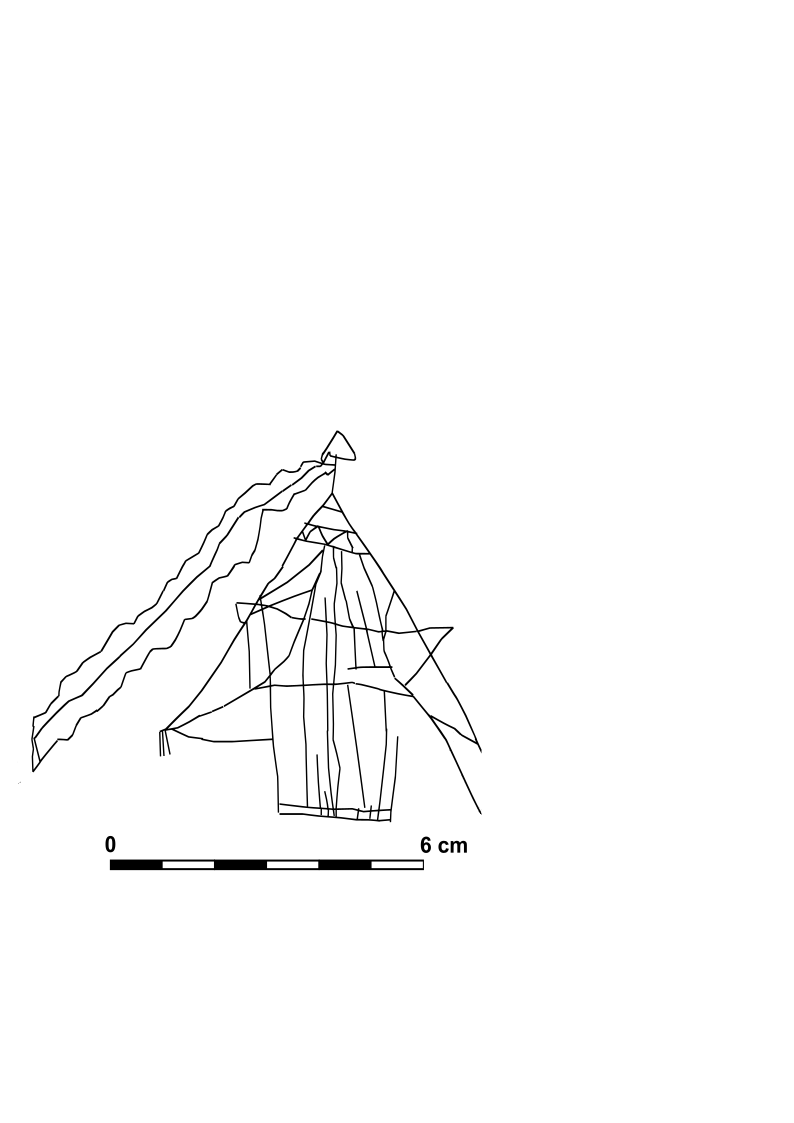
Location: On the east wall of the niche to the right of the apse.
Material: Marble surface, 6th century.
Dimensions: Height 7 cm, width 9 cm, at about 140 cm above floor level.
Condition: Shallowly carved and uninterrupted by other graffiti.
Technique: Incised.
Description: Depicted is a tall, conical tent (pavilion) with a single central pole rising to a pointed apex from which a pennant or small banner extends. The tent covering is rendered with vertical, radiating folds suggesting tensioned fabric panels fastened to a circular base. The silhouette is slender and symmetrical, emphasizing verticality and balance. At the lower edge, a slight horizontal line marks the ground or a low platform, indicating the tent’s placement within a defined area.
Attribution: Western European conical pavilion-type knight’s tent.
Publications: none.
Commentary: The carving shows clear awareness of geometric proportion and textile tension characteristic of medieval pavilion structures. The iconography corresponds precisely to the Western European chivalric tradition of military and tournament pavilions. Such tents, constructed with a single wooden mast and radial ropes, symbolized the personal space and social rank of a knight or noble. The alternating vertical panels and pointed roof recall examples from the Codex Manesse[1] and the Romance of Alexander[2], where similar structures denote the encampments of high-ranking figures.
The vertical composition and flag at the apex further reflect the Gothic preference for upward movement and heraldic display. In contrast to Byzantine or Ottoman tents—which tend to be lower and more domed—the present form demonstrates the slender elegance and symbolic individualism of Western chivalric culture.
Date: 13th–14th century AD.
[1]Cod. Pal. germ. 848, Große Heidelberger Liederhandschrift (Codex Manesse), Zürich, ca. 1300 bis ca. 1340, fol. 231r. [viewed 15 October 2025]. Universitätsbibliothek Heidelberg, Heidelberg. Available at: https://digi.ub.uni-heidelberg.de/touch/cpg848/#page/464.
[2] Bodleian Library MS. Bodl. 264, 1338–1344, fol. 83v. [viewed 15 October 2025]. Bodleian Library, Oxford. Available at: https://digital.bodleian.ox.ac.uk/objects/ae9f6cca-ae5c-4149-8fe4-95e6eca1f73c/surfaces/325930a5-8772-4753-81e4-312b3d66d6f5/. See also Grandes Chroniques de France, (FR 2813), Paris, 1375-1380, fol. 164 [viewed 15 October 2025]. Bibliothèque nationale de France, Paris. Available at: https://gallica.bnf.fr/ark:/12148/btv1b84472995/f335; Chroniques de France ou de St Denis, BL Royal 20 C VII, 1380-1400, fol. 1r, 135v, 194r. [viewed 15 October 2025]. British Library, London. Available at: https://manuscriptminiatures.com/4163/7824#image; https://manuscriptminiatures.com/4163/7837; https://manuscriptminiatures.com/4163/7841#image; ONB Cod. Vindobonensis 2762 Wenzel Bible, 1389, fol. 31, 31v. [viewed 16 October 2025]. Österreichische Nationalbibliothek, Vienna. Available at: https://manuscriptminiatures.com/4743/11715#; https://manuscriptminiatures.com/4743/11716#image; Libro de los juegos de Ajedrez, Dados y Tablas. Alfonso X el Sabio (1221-1284), Sevilla, 1283, fol.64r. [viewed 15 October 2025]. Real Biblioteca del Monasterio de San Lorenzo de El Escorial, Madrid. Available at: https://rbme.patrimonionacional.es/s/rbme/item/13125#?xywh=-332%2C6%2C2880%2C4160&cv=137.