No 16D

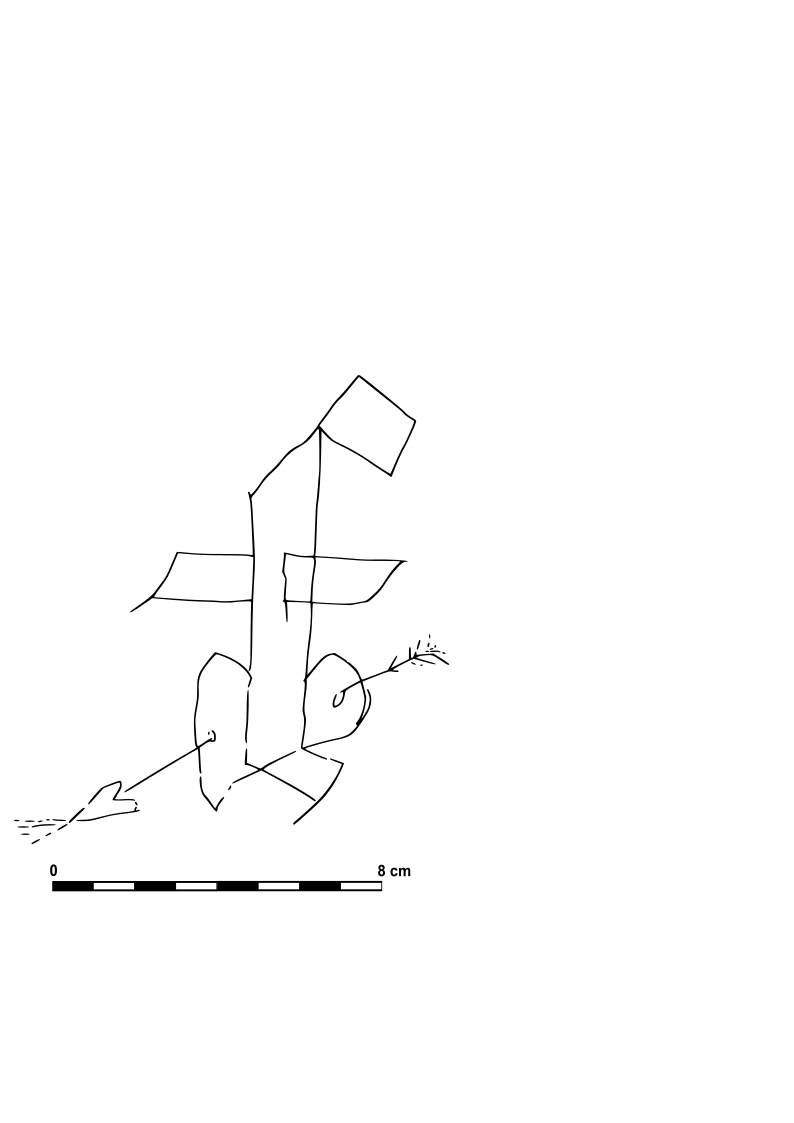
Location: On the northwest column in the western exedra of the south gallery.
Material: Marble surface, 6th century.
Dimensions: Height 10 cm, width 10.5 cm, at 170 cm from the floor.
Condition: Deeply incised, not intersected by other marks.
Technique: Incised.
Description: The drawing depicts a heart pierced by an arrow, with blood dripping from its tip. Above it stands a Gothic letter F, which also serves the function of a cross. It could mean "Frater, Frere" or, more likely in this context, "Filius".
Attribution: A symbol of the Passion of Christ, reduced to a single symbol.
Publications: Toma Tomov, Četiri grafita ot „Sv. Sofija/Aja Sofija“ v Konstantinopol/Istanbul, V: HUMANITAS, PAIDEIA, ETHOS. Sbornik v čest na prof. d-r Cvetana Čolova, Sofija: NBU, 2025, 106-109.
Commentary: Explicit devotion to the Heart of Jesus developed slowly within the Church. The first clear indications of veneration appear in the 11th and 12th centuries. Between the 13th and 16th centuries, this gradually spreading devotion, primarily among members of religious congregations—especially Franciscans, Dominicans, and Carthusians—remained within the realm of individual dedication, often of a mystical character. In the 16th and 17th centuries, however, the veneration of the Heart of Jesus advanced and entered popular piety, becoming a "fully acceptable form of Christian piety"[1] by the end of the latter century. Indeed, the Sacred Heart of Jesus is one of several images that emerged as emblematic reductions of the imagery of Christ's Passion into a single symbol. Particularly associated with the Five Wounds of Christ, the Sacred Heart depicts and embodies the wounds themselves, and its veneration was one of the most popular cults in Late Medieval Europe[2]. John Eudes (1601-1670) was the figure who transformed the devotion to the Heart of Jesus into a public phenomenon, successfully organizing a feast for it – on August 31, 1670, the first Feast of the Sacred Heart was celebrated with great solemnity in Rennes, and it soon spread to "other dioceses, encompassing various religious communities."[3].
Date: 15th – 18th century AD.
[1] O’Donnell, T. Heart of the Redeemer: An Apologia for the Contemporary and Perennial Value of the Devotion to the Sacred Heart of Jesus. Ignatius Press San Francisco, 1989, 114. Cf. Maloney, R. The Heart of Jesus In the Spirituality of Vincent de Paul and Louise de Marillac. Vincentian Heritage Journal [online], vol. 32 (1), 2014) [viewed 10 October 2025]. De Paul University Libraries. Available at: https://via.library.depaul.edu/cgi/viewcontent.cgi?referer=&httpsredir=1&article=1417&context=vhj who notes that the devotion to the Heart of Jesus evolved into “a widespread devotion called ‘Devotion to the Sacred Heart,’ with clearly formulated prayers and special adornments recommended for practice.”
[2] Murray, P., L. Murray, The Oxford Companion to Christian Art and Architecture. Oxford, New York: OUP 1998, 226 s.v. Heart, the Sacred, 32 s.v. Arma Christi; Sargent, E. The Sacred Heart: Christian Symbolism. In: J. Peto, ed. The Heart. New Haven & London: Yale UP & Wellcome Collection, 2007, 105.
[3] Two centuries later, Pope Leo XIII proclaimed Jude the author of the liturgical dedication to the Sacred Hearts of Jesus and Mary. See, for example, s. v. Heart of Jesus – Vincent and Louise [online]. In: Vincentian Encyclopedia [viewed 10 October 2025]. Available at: https://famvin.org/wiki/Heart_of_Jesus_-_Vincent_and_Louise