No 1D

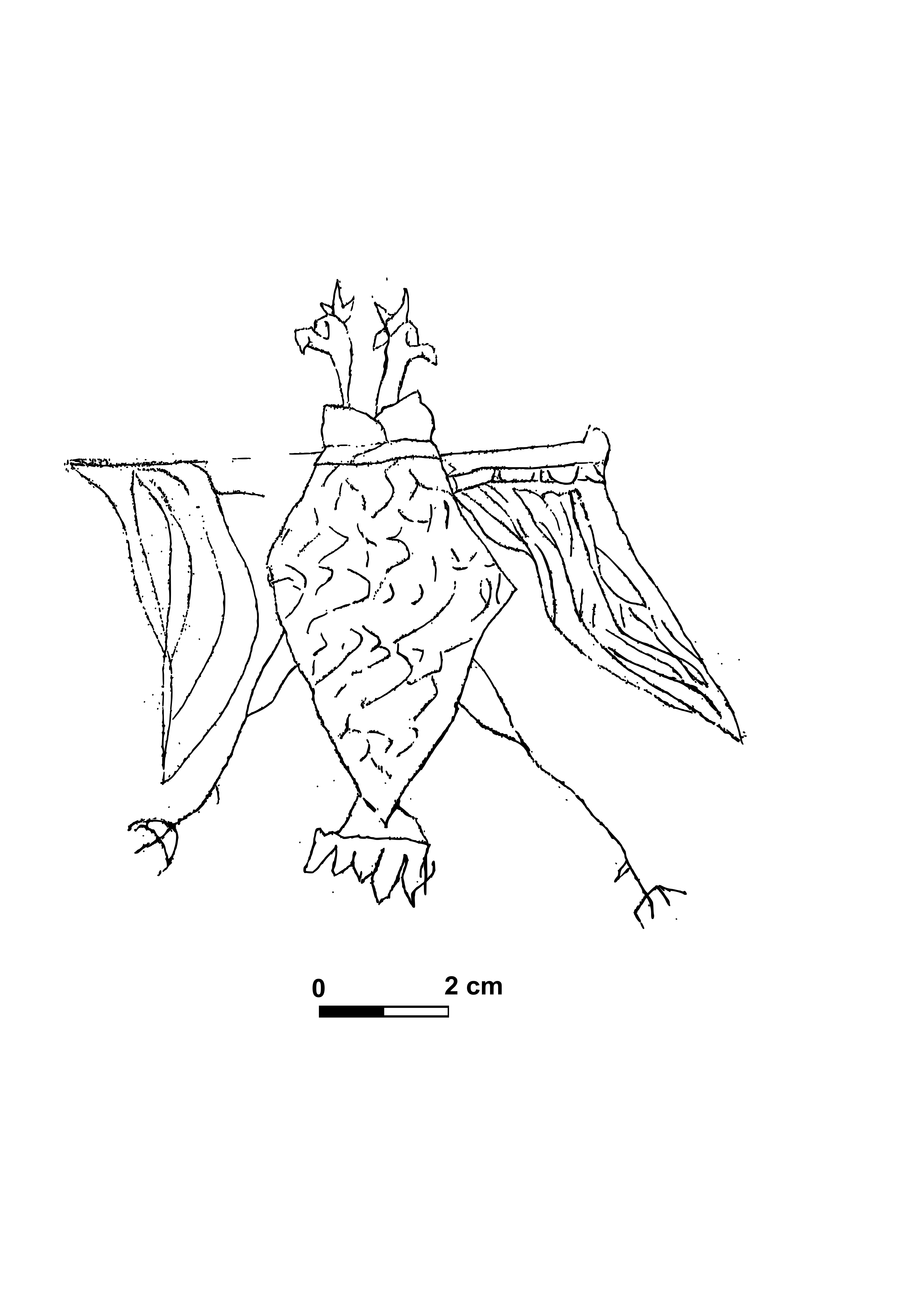
Location: On the eastern wall, at the first window from left to right, in the eastern exedra of the southern gallery.
Material: Marble surface, 6th century.
Dimensions: Height 10 cm, length 12 cm, at about 160 cm from the floor level.
Condition: Engraved lightly, with distinct carving in places.
Technique: Incised.
Description: The graffito depicts a double-headed eagle, rendered in a heraldic posture - with a powerful span of its wings. The wings are spread out but lowered, and their horizontal upper parts are adorned with thickenings. The legs are widely splayed, with toes bearing curved claws, drawn beneath the large wings gathered into points. One leg is shown with two sickle-shaped phalanges ending in sharp claws, and between them, a toe without a claw is drawn; the other leg has three toes with claws, one at the back, and at some distance above the toes - a sharp spur.
The eagle's heads have separate, straight necks with no common base. Below them, something resembling a collar is shown for each of the necks, in the form of two short bands crossed diagonally at the upper end of the body. The beaks are closed; the beak of the left head is almost straight, without a curve, while the right one has a downward-curved tip, slightly more open, and without a tongue. The eyes are wide open, and a "eyebrow" is scratched above the right one. The bird's heads, especially the right one distinctly, are crowned with symbolically depicted pointed head ornaments with a high central peak and two lower lateral peaks.
The entire body of the bird, which is represented with a "puffed-out" chest, is covered with wavy strokes imitating plumage. The wedge-shaped end of the body finishes with a short, comb-like tail formed by five elongated feathers descending downward with uneven lengths. Three of them are drawn with little swirls. The upper, horizontal part of the bird's body is rendered with an emphasized span of the wings. This is reinforced with details arranged in two lines on the right "shoulder," which ends with a rounded part at the tip and downward-hanging flight feathers - slightly curved to the side and gathered into a point.
Аttribution: An ornithomorphic image symbolizing power.
Publications: Tomov, T. Dva ornitomorfni grafita ot hrama „Sv. Sofia“, Konstantinopol, ANNUAL OF Sofia University “St. Kliment Ohridski” Faculty of History 105 (2020) 150-161.
Commentary: Tomov, T. Dva ornitomorfni grafita ot hrama „Sv. Sofia“, Konstantinopol, ANNUAL OF Sofia University “St. Kliment Ohridski” Faculty of History 105 (2020) 150-161.
Date: 14th–15th century AD.
In the numbering system (1D, 2D etc.) the letter D after the number signifies a drawing.