No 1H
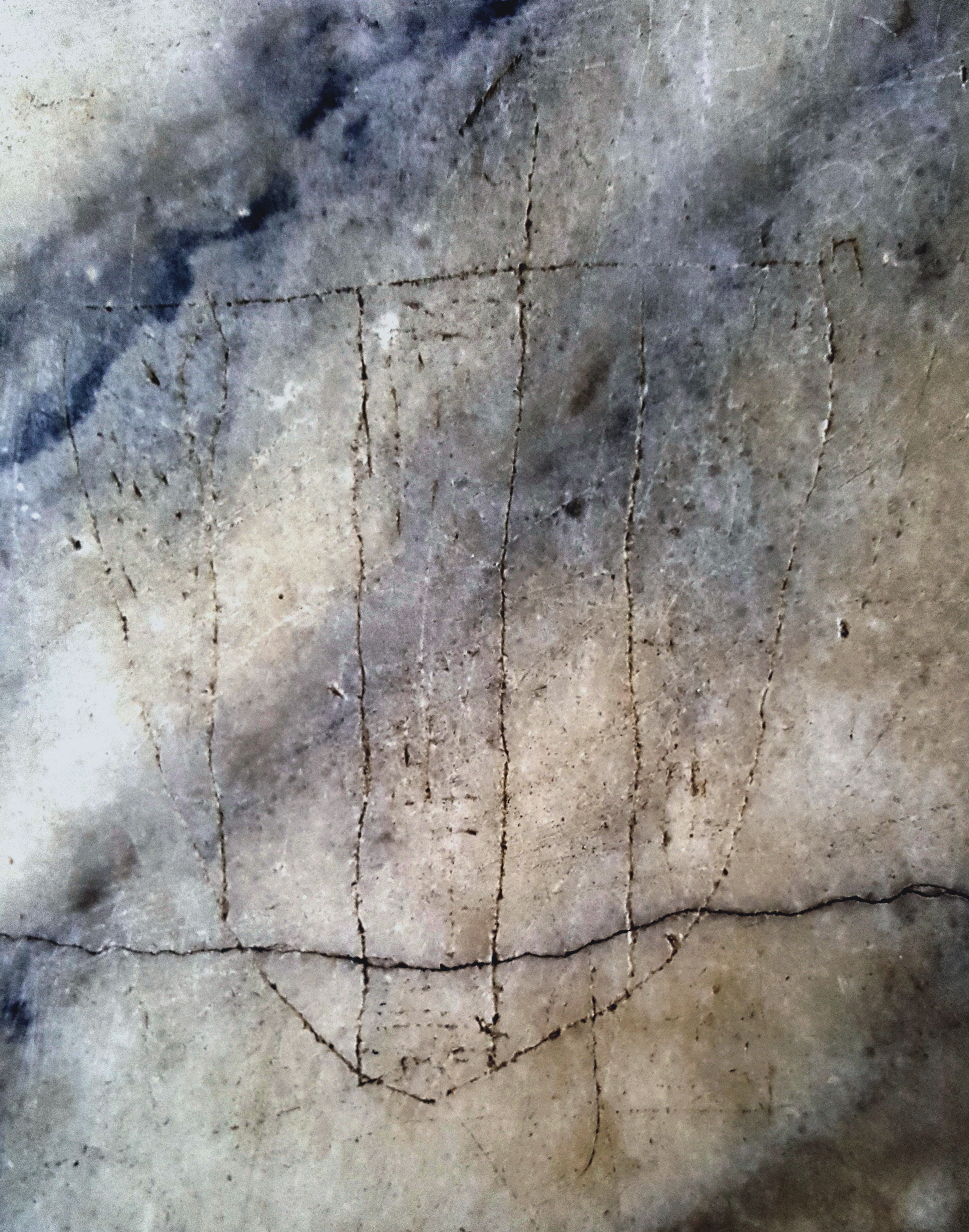
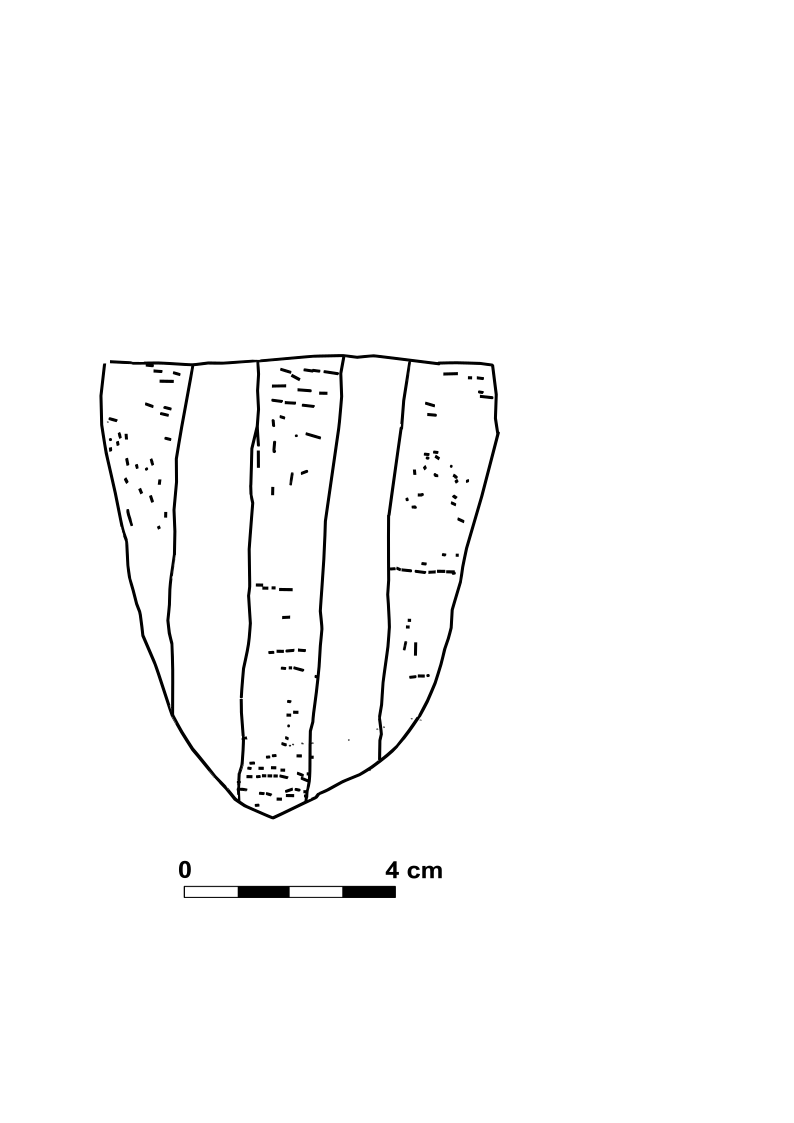
Location: Western gallery, northern end of the eastern wall.
Material: Marble surface, 6th century.
Dimensions: Width 7.5 cm, height 9.5 cm; about 150 cm above floor level.
Condition: Shallow engraving, not interlaced with other graffiti.
Technique: Incised.
Blazon: Two pillars. Gothic shield.
Аttribution (Th. Thomov): Vituri family (Venice), 1456–1586.
Attribution (M. Gorra): Indeterminable.
Publications: Tomov, T. Gerbove-grafiti ot hrama „Sv. Sofija“ v Konstantinopol, BǍLGARSKO CARSTVO. Sbornik v čest na 60-godišninata na doc. d-r Georgi N. Nikolov, Sоfia: Universitetsko izd. "Sv. Kl. Ohridski" 2018, 692-693; Gorra, Maurizio. Observations and reflections on some coats of arms graffiti in Santa Sofia in Constantinople, Academia.edu
Commentary: Well-carved, though for reasons outlined in the introduction, we must theoretically assume this also refers to a coat of arms with a different ornament (three pillars, pillar-like, etc.).
The attribution to Vituri is entirely plausible, but unfortunately the artifact offers no decisive evidence to prove it. The main source cited above describes a dozen European coats of arms similar to this graffito: among them are (Crollalanza, Enciclopedia…, cited, pp. 455 - 459; de Foras, Le blason…, cited, pp. 315 - 318) the Grimani of Venice and the Aragon family of Spain.
Nevertheless, the photograph strongly suggests the presence of small marks, not clearly identifiable but regularly scattered over the surface (see Appendix 6), which - if not random and often engraved - appear comparable to the heraldic tincture known as ermine.
If proven, this possibility would not solve the problem of attribution but would drastically reduce the number of possible coats of arms: Crollalanza, Enciclopedia…, cited, pp. 456 and 458 mention the French families Talaran and Visac, and the Spanish family Césada, which (also cited by F. Piferrer / A. Rujula y Busel, Nobiliario de los reinos y señorios de España, Madrid, M. Minuesa 1857/1860 [2nd edition], vol. III, no. 1460, pl. XIV, pp. 230 - 231; and by C. Padiglione, Trenta centurie di armi gentilizie, Naples, F. Bideri 1914, p. 271) bore as arms a red field with three (or four) pillars in ermine, matching the arms of Cardinal Gonzago Gudiel (d. 1299), visible in several polychrome mosaic pieces from the tomb of the Basilica of Santa Maria Maggiore in Rome (see Appendix 7 [author’s photo]).
Date: Indeterminable.
In the numbering system (1H, 2H etc.) the letter H after the number signifies a heraldic sign.